Meta Pixel: conversions measured on customer devices
From 12 November 2026, eligible Meta pixels start measuring conversions on the customer’s own device, matching an ad view to a later purchase using information the customer already gave the advertiser. The setting, Measure conversions on customer devices, is on by default in Meta Events Manager and is not active for people located in the EU and UK. Meta says attribution windows and models do not change; more conversions become measurable.
| Platform | Meta Ads |
|---|---|
| Feature | Measure conversions on customer devices |
| Announced | Not confirmed |
| Status | Rolling out |
| Where available | Starts 12 November 2026 for eligible pixels, according to the notice in Meta Events Manager. On by default. Not active for people located in the EU and UK. |
| Who is affected | Advertisers using the Meta pixel installed directly on their pages, on websites that require people to log in with an email address or mobile phone number. Anyone comparing Meta-reported conversions over time. |
| Action needed | Recommended. Check the setting on each pixel in Events Manager, mark 12 November in your reporting, and compare Meta-reported purchases with your own orders before and after. |
| Sources | Meta Business Help Centre: About measuring conversions on customer devices · Meta Business Help Centre: How to turn on measuring conversions on customer devices |
What changed
Meta often has a record that someone saw an ad and separately receives the purchase event from the pixel, but cannot always connect the two. Meta’s help page gives the example of someone who sees an ad for a lamp on Instagram, visits the website two days later and buys it. With this setting on, the match happens on the customer’s device, where both the ad view and the purchase are present, using information the customer already shared with the advertiser, such as an email address, and temporary, non-identifying device information. Meta says no identifying customer information is shared with it; it only receives confirmation that a purchase happened and which campaign to attribute it to.
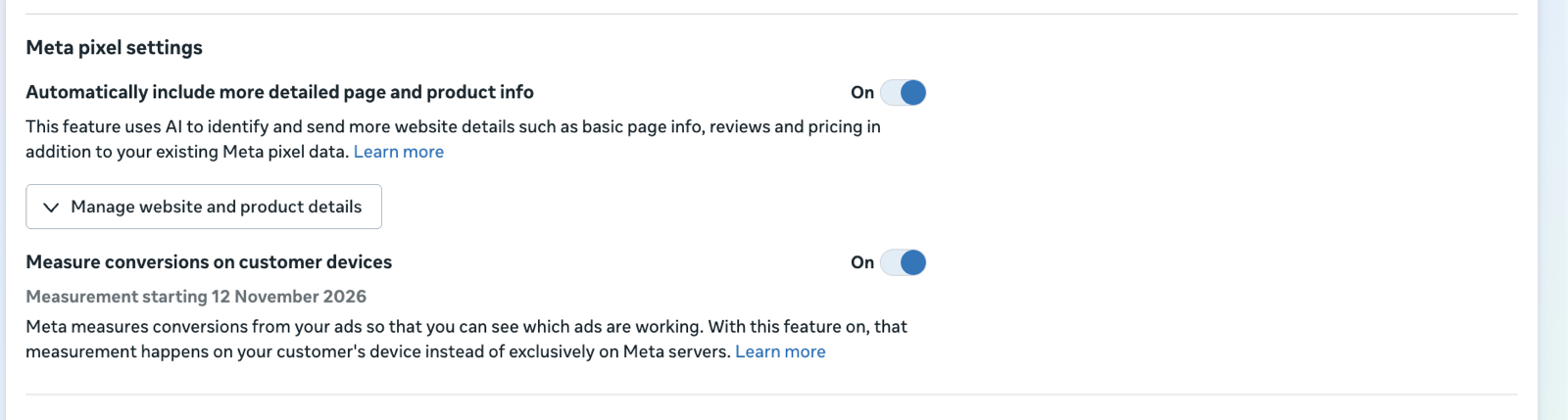
The notice in Events Manager reads: “On 12 November 2026, all eligible pixels will start measuring conversions on customer devices.” In the pixel’s settings the toggle already shows as on, labelled “Measurement starting 12 November 2026”.
Meta’s setup page lists two conditions for eligibility:
- The Meta pixel is installed directly on the page, not inside an iframe or as an image-only pixel.
- The website requires people to log in to an account using an email address or mobile phone number.
Meta says the feature works alongside an existing pixel and Conversions API setup and does not replace it. The attribution window and model stay the same: it changes which conversions can be measured, not how they are credited.
Why it matters
Reported Meta conversions on eligible pixels should rise from 12 November without a single extra sale. Purchases that were already happening, and that Meta could not tie to an ad, start appearing in campaign reporting. That is good for optimisation, because Meta’s delivery system gets a stronger signal, which is the main reason Meta gives for keeping it on. It is bad for anyone who reads a jump in reported ROAS in late November as campaign improvement, or who compares this year’s Q4 with last year’s.
The eligibility rule narrows who sees the effect. A store with guest checkout and no required login does not meet Meta’s stated condition; a subscription business, a marketplace or a course platform where every buyer has an account is the typical fit. Our view: leave it on, because more measured conversions help Meta optimise, but annotate the date and judge campaigns against your own order data for the first few weeks, not against Meta’s reported numbers alone.
What to do
- In Meta Events Manager, open Data sources, select each pixel, click Settings and check Measure conversions on customer devices in the Meta pixel settings section. The setting is per pixel.
- Check eligibility: confirm the pixel is installed directly on your pages rather than in an iframe or as an image pixel, and whether your site requires login with an email or phone number.
- Add a note on 12 November in your reporting dashboards and Ads Manager exports so later comparisons account for the change.
- For two to four weeks either side of 12 November, compare Meta-reported purchases with orders in your own backend to see how much of any increase is newly measured rather than new.
- If your privacy policy or client agreements limit this kind of processing, decide before 12 November; the toggle can be turned off at any time.
Still unknown
Meta’s help pages do not give the start date; 12 November 2026 comes from the notice and setting label in Events Manager. Meta has not said how many more conversions advertisers should expect, what the temporary device information consists of, or how pixels on sites that do not require login are treated in practice. Meta’s pages describe purchases; they do not say whether other conversion events are measured the same way.
Frequently asked questions
What is Measure conversions on customer devices in Meta Events Manager?
A Meta pixel setting that matches an ad view to a purchase on the customer’s own device, using information the customer already shared with the advertiser, such as an email address, and temporary, non-identifying device information. Meta says it only receives confirmation that a purchase happened and which campaign to attribute it to.
Is Measure conversions on customer devices on by default?
Yes. Meta says it is on by default for eligible pixels and can be turned off at any time in Events Manager under Data sources, your pixel, Settings, in the Meta pixel settings section.
Does it change Meta’s attribution window?
No. Meta says the attribution window and attribution model do not change; the setting affects which conversions can be measured, not how they are credited to ads.
Does it apply in the EU and UK?
No. Meta says measuring conversions on customer devices is not active for people located in the EU and UK.
Official sources
- Meta Business Help Centre: About measuring conversions on customer devices ↗
- Meta Business Help Centre: How to turn on measuring conversions on customer devices ↗
Related coverage
- Meta Ads placements: no manual choice for Sales, Leads, Apps
- Meta Ads Manager Creative diversity column: how to read it
- Meta ad ranking: Andromeda, GEM and GenRecs upgrades explained
Update history
- — First coverage, from Meta’s two help pages and the notice in Events Manager. Includes Piyush’s take and his screenshot.
Suggested checks are editorial guidance, not platform requirements. Every claim links to its official source. Report a correction →