Meta ad ranking: Andromeda, GEM and GenRecs upgrades explained
Meta has upgraded the AI systems that decide which ads people see on Facebook and Instagram, and explained them in two posts on 28 October 2026. The changes apply to every campaign automatically. There is nothing to turn on, but the posts explain why Meta keeps pushing broad targeting, conversion values and more creative variety.
| Platform | Meta Ads |
|---|---|
| Feature | Meta ads ranking (Andromeda, GEM, GenRecs) |
| Announced | Oct 28, 2026 |
| Status | Available |
| Where available | Live for all advertisers and applied automatically, according to Meta on 28 October 2026. Generative retrieval runs on Facebook Feed since Q3 2026. Meta names no countries. |
| Who is affected | All Facebook and Instagram campaigns, including Reels and conversions off Meta. |
| Action needed | None required. Meta’s advice: optimise for the outcome you actually want, send conversion values, use Advantage+ and give the system more creative variety. |
| Sources | Meta for Business: Three new AI innovations in ads ranking · Meta for Business: How Meta’s ads system matches your ad to the right person |
What changed
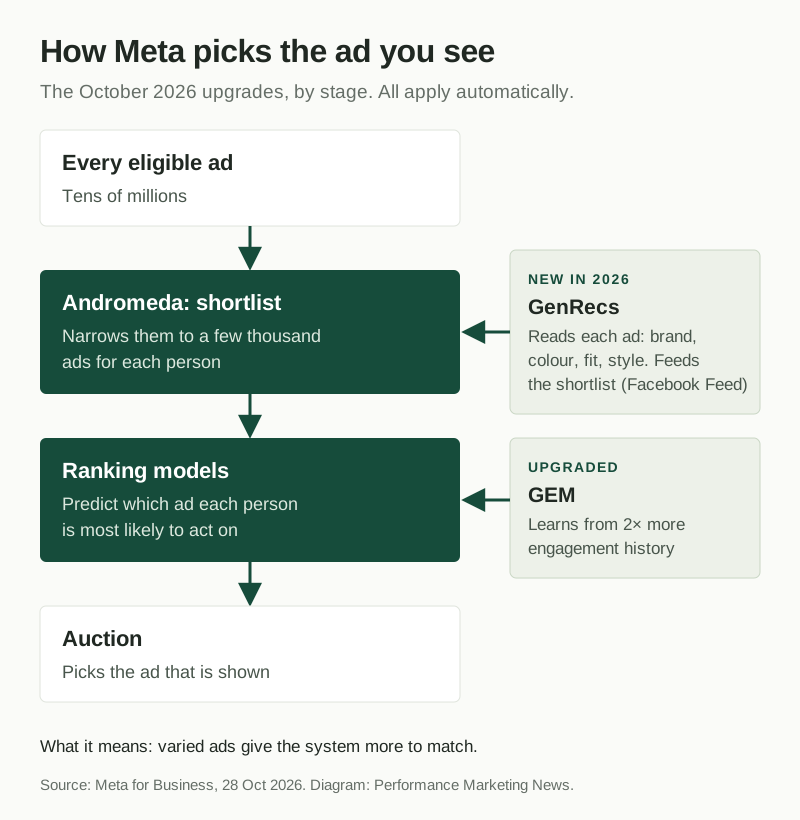
Meta’s ads system picks an ad in stages: first it finds a shortlist of eligible ads for a person, then it ranks them. Its post on ranking describes three systems:
- Andromeda (finding the shortlist). Narrows tens of millions of ads to a few thousand per person. A new version built with NVIDIA sends each ad to specialised models and scores more than a billion ads a second. Meta says making it ten times more complex in Q3 2026 lifted conversions by 1.37% on Facebook and 0.24% on Instagram Reels.
- GEM (learning what people respond to). Meta’s foundation model for ad recommendations across Facebook, Instagram, Reels and conversions off Meta. It now reads twice as much engagement history. Meta says it also helps campaigns with few conversions by learning from click data. Meta reports up to 18.9% more conversions and 12% higher click-through rate since 2025.
- GenRecs (understanding the ad itself). New in 2026. It uses large language models to describe each ad by traits such as brand, colour, fit and style, so the system can match new ads with little history. Since Q3 2026 it powers generative retrieval on Facebook Feed, which Meta says added nearly 2% conversions in the segments it targeted.
The second post explains the whole system for advertisers and repeats Meta’s advice:
- Optimise for the outcome you actually want, not the closest thing that’s easy to measure.
- Send conversion values so the system favours your most valuable customers.
- Use Advantage+ as a whole rather than one setting at a time, and give it more creative variety.
- Judge results by cost per result or ROAS, and test incrementality with Conversion Lift or Brand Lift.
- Fix the customer experience (delivery, support, checkout), because it affects ad quality.
- Protect budget for peak seasons and use budget scheduling.
Why it matters
Nothing here needs a change in Ads Manager. What it does is explain Meta’s direction. GenRecs reads what is in each ad, and Andromeda now considers far more ads per person. Ten versions of the same image give the system little to work with. Ads that differ in format, message and product give it more to match.
The numbers are Meta’s own, mostly without a test method or time period. Treat them as the direction of travel, not a forecast for your account.
What to do
- Check that each campaign optimises for the real goal (a purchase or qualified lead), not an easier event such as a landing-page view.
- If you sell products with different margins, send purchase values and test value optimisation.
- Review your active ads: if most are small variations of one idea, add genuinely different formats, hooks and products.
- Judge any change in results against your own sales data or a lift test, not Ads Manager alone.
Still unknown
Meta gives no countries or dates for each system beyond the quarters above, and no test design for most of its figures. It hasn’t said whether generative retrieval will reach Instagram or other placements.
Frequently asked questions
What is Meta Andromeda?
Andromeda is the first stage of Meta’s ad ranking. It narrows tens of millions of eligible ads to a shortlist of a few thousand for each person. Its latest version routes each ad to specialised models and scores over a billion ads a second.
What is Meta GEM?
GEM, the Generative Ads Recommendation Model, is the foundation model behind Meta’s ad recommendations across Facebook, Instagram, Reels and off-Meta conversions. Meta says it now reads twice as much engagement history and helps campaigns with few conversions.
What is Meta GenRecs?
GenRecs, the Generative Recommender, uses large language models to describe each ad by traits such as brand, colour, fit and style. That helps the system match new or low-engagement ads. It has powered generative retrieval on Facebook Feed since Q3 2026.
Do I need to change anything in Ads Manager for these Meta updates?
No. Meta says the upgrades apply to all campaigns automatically, with no setting, new campaign type or migration.
Official sources
- Meta for Business: Three new AI innovations in ads ranking ↗ · Oct 28, 2026
- Meta for Business: How Meta’s ads system matches your ad to the right person ↗ · Oct 28, 2026
Related coverage
- Meta Ads Manager Creative diversity column: how to read it
- Meta Ads Super Burst: reserve 3 to 24 hour brand windows
- Meta ads MCP server: manage ads from AI tools, with agent rules
Update history
- — First coverage of Meta’s 28 October 2026 posts on its ad ranking systems; sources checked on 29 October.
Suggested checks are editorial guidance, not platform requirements. Every claim links to its official source. Report a correction →